
Insulation Before & After in Union City, CA
Photos don’t lie. A blower-door reading of 4,200 CFM50 dropping to 2,100 tells one story; the photo of compressed, rodent-compromised fiberglass getting replaced with properly installed blown-in cellulose tells another. Below are real jobs we’ve completed in Union City, from the Decoto District up to the newer builds near the BART station. Each entry shows what we found, what we did, and what the homeowner walked away with.
Recent Transformations
Attic Insulation Removal & Replacement - Decoto District, 1960s Ranch
The homeowner in the Decoto District called us after two winters of PG&E bills climbing past $340. We pulled back the existing fiberglass and found it compressed to maybe three inches in spots, with original 1960s top plates completely unsealed. We air-sealed every penetration, installed baffles at the eaves for proper ventilation, then blew GreenFiber cellulose to a consistent R-38. The blower-door test - a pressurization reading that shows, in one number, how much air your building envelope is losing - read 3,800 CFM50 when we arrived and 1,950 when we left. Written scope, written price, photo record. Done in one day.
Crawl Space Encapsulation & Vapor Barrier - Near Alvarado-Niles Road, 1970s Split-Level
This split-level near Alvarado-Niles Road had a classic Union City problem: clay-heavy soil that holds moisture against the foundation, plus original vented crawl space design that pulls humid summer air directly under the living floor. The fiberglass batts were sagging and black-spotted. We removed them, graded the soil, laid a 20-mil reinforced vapor barrier sealed to the walls with tape and mastic, then sprayed two inches of Demilec closed-cell foam on the rim joists. A small dehumidifier with a direct drain line keeps the space below 55% relative humidity year-round. No more musty smell rising through the floor registers.
Spray Foam Insulation - Newer Build Near Union City BART, 2005 Townhouse
The townhome cluster near the BART station was built with kneewall attics that are technically “inside” the house but functionally outside - fiberglass batts with no air barrier, so the master bedroom was roasting in summer and cold in winter. We sprayed Icynene open-cell foam on the kneewalls and roof deck, bringing the attic fully into the conditioned envelope. The HVAC ductwork, previously sitting in 140-degree summer attic air, now runs in 75-degree space. The homeowner’s summer cooling load dropped enough that their existing two-ton unit finally cycles properly instead of running flat-out.
Radiant Barrier Installation - Hillcrest Area, 1980s Two-Story
The Hillcrest area gets afternoon sun straight off the bay with no marine layer buffer, and this two-story had a dark shingle roof that turned the attic into a radiator. We didn’t replace the existing insulation; instead we installed an Owens Corning radiant barrier on the rafters with proper two-inch ventilation channels so the roof deck can still dry. Attic peak temperature dropped from 147°F to 119°F on a 95-degree day. The upstairs bedrooms, previously unusable until 10 PM in July, now cool down by 7 PM. Sometimes the right fix isn’t more insulation; it’s stopping the heat before it gets in.
Attic Air Sealing & Blown-In Top-Up - Station District, 1950s Bungalow
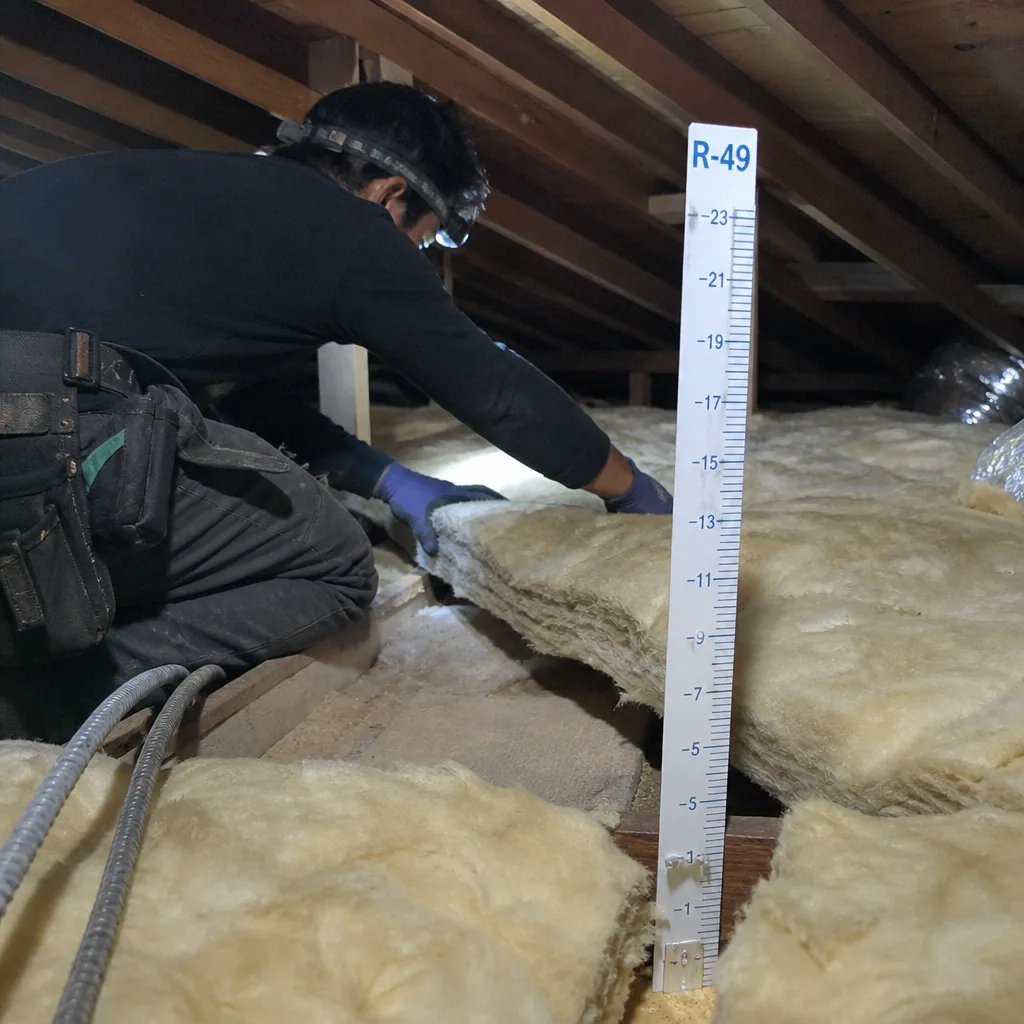
This Station District bungalow still had its original rock wool, which isn’t bad insulation but had been trampled by three generations of electricians and HVAC techs. Worse, the chimney chase - a three-story brick column running through the center of the house - had a half-inch gap around it that was pulling conditioned air straight into the flue cavity. We used fire-rated foam and sheet metal flashing to seal the chase, installed ten pre-approved can light covers, then blew Knauf fiberglass to R-49. The blower door started at 5,100 CFM50, which is enormous for a 1,200-square-foot house, and finished at 2,400. The homeowner said the furnace used to run constantly; now it cycles and rests.
Insulation Removal After Rodent Damage - Near Logan High School, 1990s Tract Home
The roof rat problem in Union City isn’t subtle once they’re in your attic. This home near Logan High School had bats that had been nesting in the fiberglass for two seasons, with droppings compacted into the lower layers and wiring chewed down to copper. We don’t do pest control, but we do the cleanup after. Our crew suited up, HEPA-vacuumed every square inch of decking, applied disinfectant, then worked with the homeowner’s pest company to seal entry points with hardware cloth before we blew new cellulose. Under Haven Standard: we don’t put new insulation over contamination, and we document the clean deck with photos before anything goes back in.
Want Results Like These?
Every job above started the same way: a homeowner called (650) 381-1512, we scheduled a walk-through, and they got a written price before any work started. No exceptions, no surprises. We serve Union City and 17 surrounding communities, with live people answering calls 24/7. If you’ve got a competing quote, bring it in - we’ll read it with you line by line under our Free Second Opinion. Call (650) 381-1512 or stop by to talk through what your attic or crawl space actually needs.
Written by Wes Okafor, Owner at Topside Attic Insulation Union City, serving Union City since 2016.